« February 2008 | Main | April 2008 »

March 2008

March 30, 2008

Creating a Power Offer

My post on Why Airline Mergers Don’t Work concluded with this double whammy:

Painful price elasticity combines with zero earnings elasticity to squash earnings in the proposed merger between Delta (NYSE: DAL) and Northwest (NYSE: NWA).

The statement was based on the principles in Competing for Customers and Capital, perhaps the only analysis of its kind that could identify this crippling dilemma.

What’s an airline CEO to do in this situation? I recommended they read J.C. Larreche’s book The Momentum Effect for possible cures to what ails them. Here’s what Sir Richard Branson, who knows a thing or two about the airline business, says on the cover jacket:

This book shows you how to build momentum and leave your competitors trailing in your wake.

What might an airline CEO learn from it? I admit, perhaps not the same things I have learned. But here is one insight that jumped from the pages of The Momentum Effect [TME] as I read.

VIBRANT SATISFACTION
The relationship most air carriers have with passengers never develops beyond their onboard experiences, online booking and ticket purchases. As Professor Larrache said:

There is no emotional connection. To generate the momentum effect requires a much deeper and more committed relationship than that offered by passive customers who just don’t complain. Companies should measure their success by the number of delighted customers they have—people so thrilled with a product or service that they can’t help but tell others about it.

Aiming to satisfy customers is not enough. That is an average, complacent, and mediocre goal. Momentum-powered firms are more ambitious in their customer satisfaction objectives. Their target is truly intense, can’t-imagine-any-better satisfaction—vibrant satisfaction (p. 152).

Would offering a non-stop flight in place of a connecting one create vibrant satisfaction? Not really. While non-stop flights are desirable, we’ve all learned to live without them. Finding a non-stop flight is great, but it does not create vibrant satisfaction. A non-stop flight is not something for which you would say: I can’t imagine anything more satisfying in air travel. What sort of air travel service might lead you to express vibrant satisfaction?

WHEN LESS IS MORE
We often hear the idea that “less is more.” But that concept always is expressed in terms of money. The following sentence from TME explains when less is more from the passenger’s point of view:

For [passengers], less should mean that they get exactly what they need and nothing more, with no superfluous elements that create complexity and could destroy value (p.27).

Reading this sentence started me thinking: In my experience are there any airline services that create complexity and destroy value?

SIX TRIPS TO WPB
Two of my sons and grandsons live in West Palm Beach, Florida. So I travel there on a first-class senior fare about six times a year. Currently that fare runs about $1,100 per round-trip. All the flights offered by Continental Airlines (NYSR: CAL) have a plane change in Houston. Usually I check one large suitcase carefully packed with shoes, shirts, sport-coats and several suits surrounding a MacBook Pro wrapped in a towel, plus toiletries packed in plastic bags or snap-tight containers.

I’ve been making this trip on the same CAL connecting flights six times a year for several years. Even so the TSA inspectors take my checked bag apart and throw my suits, shirts, ties, socks and shoes back in wrinkled mess with a little flyer announcing their inspection. As if I couldn’t see they had been there.

THE CURSE OF CHECKED BAGGAGE
On every trip we pay so much attention to our luggage that one might think it mattered more than ourselves. We pack our clothes and toiletries in a suitcase, carry it to the airport, check it and expect the TSA to inspect it. Then we roll it to a taxi or shuttle, take it to a hotel or other venue, unpack and lay out stuff for the next day. And the days after.

Then we replay the process in reverse by returning the clothing and toiletries to our suitcase. We carry it to the airport, check-in for TSA inspection, retrieve it from baggage handling at the end of the flight and take it home to unpack. If it's not lost in handling!

Finally, our local cleaning service picks up the dirty clothes to wash and/or dry clean them. Two days later the service returns the cleaning and we put it put away. There it waits in our dresser for the next trip.

This is an endless, superfluous cycle of baggage handling, and re-handling, and re-re-handling. A cycle of unnecessary complexity that often destroys what ever value might be created by an on-time arrival. Why do first-class airline passengers need to check their baggage? If you think about it, we really don’t. We don’t need “baggage handling” as we know it. What we actually need is another set of clothes and toiletries at our destination.

How could an airline provide another set of clothes and toiletries at a passenger’s destination? By taking on more of the responsibility for them. There are at least two possibilities.

EXPRESS SHIPMENT
Probably the simplest option is for the carrier to partner with FedEx (NYSE: FDX) or UPS (NYSE: UPS) to pick up our baggage from home the day of our departure and deliver it to our destination timed with our flight arrival. With this option our baggage never goes thorough the passenger air transportation system. No baggage to carry to the airport and check-in. No TSA inspection. No waiting at the baggage carrousel to pick it up. Then, just before our return flight, the express service picks up our baggage at the hotel and returns it to our home timed with our arrival.

But this simple solution has one major drawback. It’s simple for the air carrier, but not for the passenger. For example, the express shipment option avoids some of the curses of checked baggage, but not all of them. It's less likely to get lost. But, we still have to pack the suitcase, make an appointment to have it picked up by the express shipper and wait for the truck to arrive. Then on the return trip we have to be home to receive the baggage.

We still must sort the clothing and give it to our cleaning service. Then store it away till the next time we need it. When that day arrives, we must repack the suitcase and wait for the express shipping service to pick it up. We never think of these chores as much of a burden because we always do them. But what if we didn’t need to?

PERSONAL VALET
Another -- far more personal -- option is for the carrier to create a travel partnership with each of its first-class passengers. Roughly speaking, here’s how a personal valet service built on that partnetship might work.

Each partner is issued his or her own Certified Airtravel Valise [CAV]. A coded travel-partner number is etched in the rigid frame of each CAV. Multiple CAVs are available in various sizes and functions (e.g. hanging bag, shoe case).

Initially, travel-partners pack their own set of clothing and toiletries in their valise. Then, before the very first flight with the service, the CAV is picked up by the carrier and stored in a special section of its baggage handling facilities at the local airport. This secure section is dedicated to handling only the airline travel-partners’ baggage. The security must be such that the TSA will approve CAVs as pre-inspected baggage. Securing TSA approval would require careful planning of security safe-guards by the airline.

Whenever the carrier’s first-class travel partner flies to any domestic destination, his or her CAV flies on board the same plane (without inspection) and it is delivered to the hotel or other venue where the passenger is staying. This saves schlepping it from baggage-handling to the taxi and on to the hotel.

On the return trip the CAV is picked up at the hotel by the carrier and loaded on the flight to his or her local airport. Then it's delivered to the passenger’s own valet service where it is dry and/or wet cleaned, repacked in the travel-partners CAV, picked up by the carrier and stored in the private airport lock-up till the next trip. The costs of the cleaning services are billed to the travel partner’s personal account with that vendor. The value of this service will be built into first-class fares for travel partners. This is what JC would call a “power offer.”

EFFECT OF POWER OFFERS
Power offers have a huge effect. First, they create compelling value both for the customer and for the company. Second, a deep emotional engagement drives vibrant satisfaction. Third, a power offer cannot be easily duplicated by a competitor. This leads to higher customer retention levels.

Power offers are a continuous and essential activity in creating and sustaining momentum. As JC describes it:

The accelerating effects of four related components: power offer, vibrant levels of customer satisfaction, retention, and engagement, lend a potent thrust to momentum. These four components support each other in a virtuous circle (p. 151).

EXECUTING A POWER OFFER
It’s easier to define a power offer than to deliver one. What’s required for Continental Airlines to deliver on the promise of a passenger valet service for its first-class passengers? What do you think?

Thanks for visiting. As always, your comments are welcome.

~V

Full disclosure: I recommend this book as a co-author with a long history of collaboration.
March 23, 2008

Why Airline Mergers Don't Work

Ever wonder why over the last 30 years Southwest Airlines managers (NYSE: LUV) spent only $0.03 on mergers and acquisitions for every $1.00 of shareholder value they created? By comparison Delta management (NYSE: DAL) spent $2.35 for every $1.00 of value they created. And Northwest (NYSE: NWA) spent $1.61 on M&A for every value dollar they created. In Louisiana we have a name for this kind of strategy. It's called jumping over a dollar to get to a nickel.

Does Herb Kelleher, former CEO of Southwest Airlines, know something about creating shareholder value that other CEOs don’t know? Perhaps he understands that in the domestic airline market earnings don’t necessarily increase with market share. Or in economics speak, changes in earnings with respect to a changes in market share may be very inelastic. Because the demand for air travel is very price elastic.

BELIEVE IT OR NOT
Believe it or not, elasticity is one of the most powerful metrics in business. In a single number, elasticity pins to the wall the relationship between percentage changes in price and quantity. In theory, if the percent change in quantity purchased by customers is greater than the percent change in price paid, demand is elastic. Alternatively, if the percent change in quantity is less than the percent change in price, demand is inelastic. Then why does one rarely see price elasticity numbers used in industry analyses? In the real world, price and quantity data are notoriously ill behaved. That’s why your econ 101 professor couldn’t use real numbers in his or her hand-drawn demand schedules. The axes on the graphs were always labeled p1, p2 and q1, q2. Remember?

It is, however, possible to get at the relationship between price and quantity in the real world. If you have access to a large base of precise data, an in-depth knowledge of econometric methods and lot’s of time on your hands. About the only people I know with these resources are doctoral students in economics. So I was not surprised to find exactly what I was looking for in Jong-Ho Kim’s 2006 dissertation on “Price Dispersion in the Airline Industry: The Effect of Industry Elasticity on Cross-Price Elasticity.” You can buy and download a copy of it from University Microfilms.

Dr. Kim based his research on data from the Department of Transportation’s Origin and Destination Survey from the 1st quarter 1989 through the 4th quarter 1997. This is a 10% random sample of all tickets issued in the U.S. In his dissertation Dr. Kim hypothesized that:

Southwest’s entry provides a natural setting for investigating how travelers respond to the changes in air fares. More specifically, we can make full use of variations in relative prices among airlines and the revenue shares of airlines by focusing on Southwest entry routes. Consequently, we can focus on coach class travel in those markets where Southwest entered and has been serving since then. … rival airlines adjust their average fares upon Southwest’s entry and remain relatively constant in ensuing quarters (page 12).

In that study when Southwest entered a new market (city-pair) estimated price elasticity ranged from a high of -2.6 (with only one other competitor), to -1.63 (with four other competitors), to a low of -1.1 (with 7 other competitors). All of these estimates were statistically significant.

WHAT HERB KNOWS
I think Herb Kelleher understands – as no sitting airline CEOs seems to – this fundamental principle about competition: given

• a capital intensive industry,
• with few meaningful scale efficiencies,
• delivering a highly perishable product,
• within a partly regulated infrastructure,
• operated by talented professionals,
• in a very price sensitive market, with
• free entry and court protected exit,

shareholder value can best be created organically. How? By maximizing the satisfaction of employees, passengers, suppliers, partners, and shareholders. Here is the corollary to that fundamental principle:

In airlines, building market share through mergers
short circuits the creation of satisfied stakeholders.

The purpose of this article is to examine why mergers don’t work today in domestic airlines, using the DAL/NWA merger as an example.

EARNINGS ELASTICITY
Elasticity can be expressed for any pair of variables. Take earnings elasticity for example. It’s the percent change in earnings divided by the percent change in market share. Here’s what happens. Cutting price leads to an increase in market share. But it also leads to a decrease in earnings. Theoretically, in a price elastic market with few scale efficiencies and a perishable product, earnings and market share are not happy partners.

Suppose the management of a hypothetical airline with 20% of all domestic revenues decides it would be good for earnings if they increased share of revenues to 30%. The quickest way to do that is to merge with a company that has 10% of the market. In a matter of months its market share increases by 50%. Bingo! But in a highly price sensitive market for a perishable product, earnings may increase only a little, say about 6%. The ratio of the percent change in earnings to the percent change in market share (0.06/0.50) is just 0.12. In this hypothetical case, earnings are highly inelastic with respect to market share. Is this is a bad thing? Yes. It’s a classic case of jumping over a dollar to get to a nickel.

MAXIMUM EARNINGS MARKET SHARE
To test the hypothesis that the DAL/NWA merger won’t be good for shareholders I ran a maximum earnings market share analysis on the combined companies in a strategic group with seven other domestic airlines for the calendar year 2007.

In a nutshell, maximum earnings occur when EBITDA generated by the last share point exactly equals the cost of acquiring it. I worked out the details of how to calculate maximum earnings share in my book Competing for Customers and Capital. I applied the results to eight domestic airlines in the 1st quarter of 2003 when only two of them weren’t losing money. If you want to get an overview of that analysis see my audio slide show The Rule of Maximum Earnings. It’s short and no walk in the park.

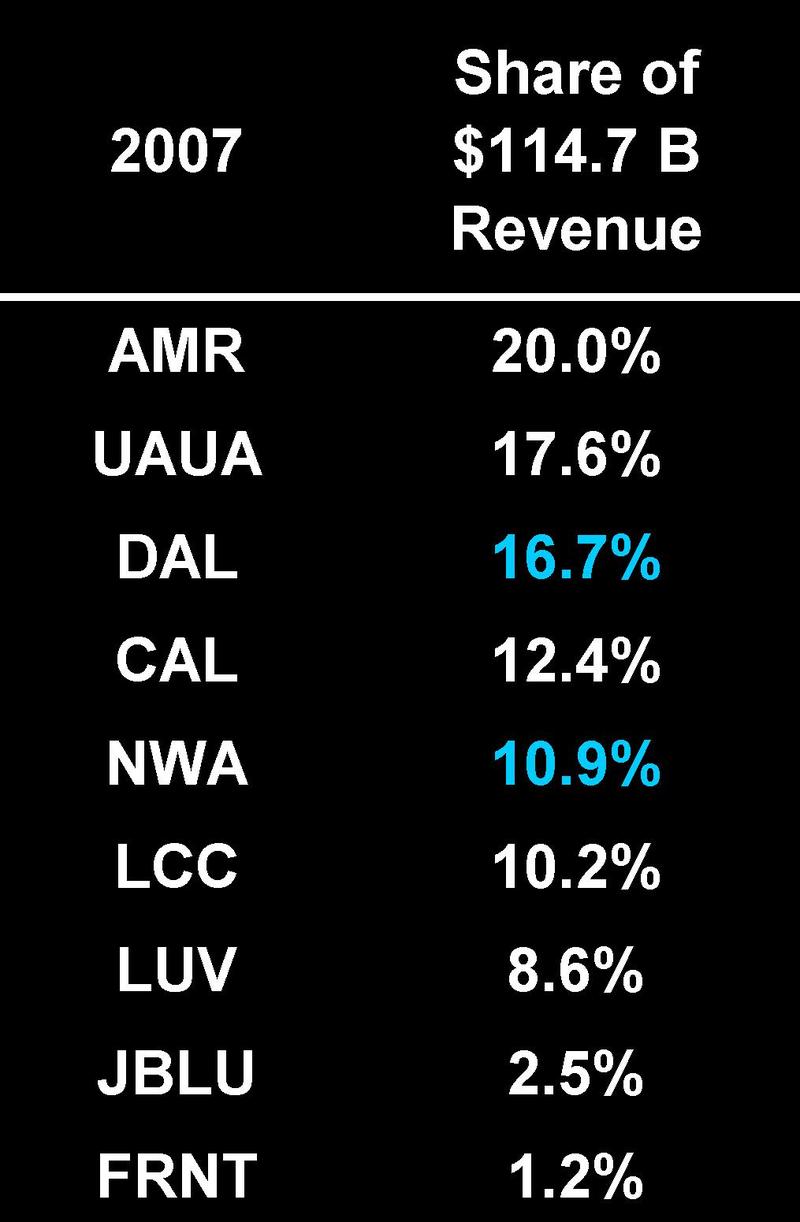
Table 1 sets the stage for this analysis with each carrier’s share of the combined $114.7 billion revenues in calendar 2007. American Airlines (NYSE: AMR) captured 20.0% of total revenue. UAL Corp (NasdaqGS: UAUA) walked away with 17.6%; Delta and NWA got 16.7% and 10.9% respectively.

Table 1

02_airline_market_shares_2007

Continental (NYSE: CAL) generated 12.4%; US Airways ((NYSE: LCC) had 10.2%; followed by Southwest with 8.6%; Jet Blue (NasdaqGS: JBLU) at 2.5%; and Frontier (NasdaqGM: FRNT) with 1.2% of group revenues.

Combined, DAL and NWA actually captured 27.6% of total revenues. Since both carriers were financially cleansed by bankruptcy court, what is your guess about their potential to maximize earnings? The answer appears in Chart 1.

Chart 1

01_dalnwa_earnings_and_costs_per_po

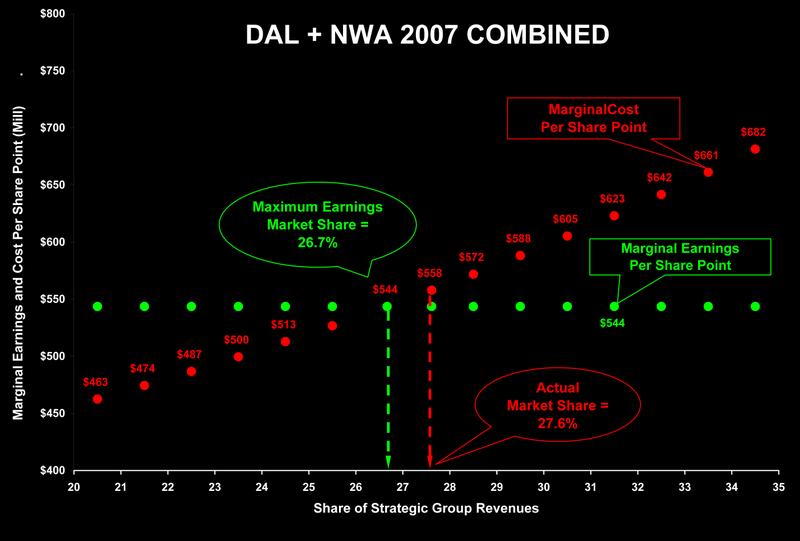
Combining DAL & NWA revenue and costs as they appeared on their individual income statements produced an actual 2007 market share of 27.6% of group revenues. The vertical axis on this chart is the marginal cost (the red schedule) as well as marginal earnings (the green schedule) per share point.

Marginal costs continuously increase reflecting the underlying reality of competition. The marginal earnings schedule is constant, reflecting the assumption that there would be no major changes in the scale of combined operations. Under this assumption, maximum earnings market share is 26.7% of group revenues. If synergies were to be found after merging, the effect would be to push actual and maximum earnings market share even closer together. In either event, the combined companies come within no more than 90 basis points of realizing maximum earnings. That’s the good news.

TOTAL EARNINGS ALMOST AS FLAT
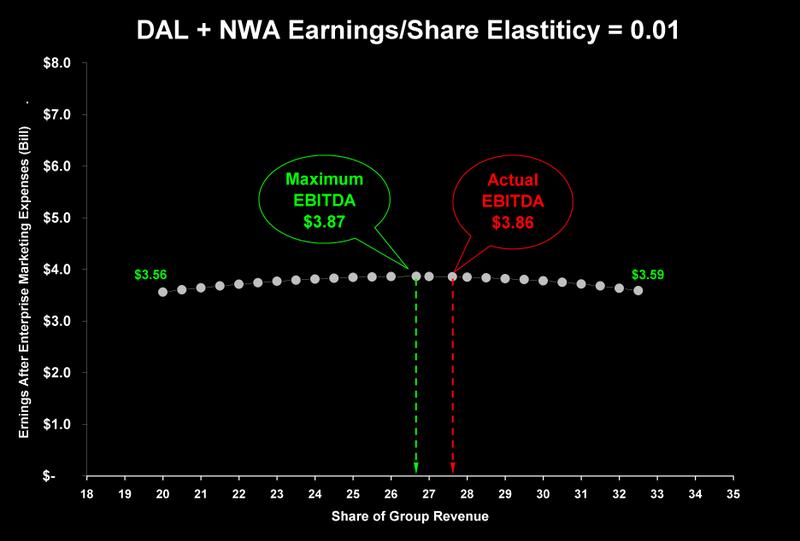
The bad news is the total earnings schedule is almost as flat at the marginal earnings schedule. Chart 2 tells the story.

Chart 2

0_dalnwa_earnings_elasticity_is_012

In Chart 2 market share appears on the horizontal axis ranging from 20% through 35% of group revenue. In this chart, total earnings appear on the vertical axis ranging from zero to $8 billion. There is just a $10 million difference between actual and maximum earnings.

A DOUBLE WHAMMY
I began this article by pointing to the painful price elasticity that exists in this capital intensive market for perishable products. For carriers competing with Southwest in the same city-pair, reported price elasticities range from -1.1 upwards to -2.6 depending on the number of competitors in the market. If you’re the only other carrier in a market with a 10% price premium in a city-pair boarding 1,000 passengers a day, 260 of them likely will switch to Southwest. So you have to match LUV’s price.   If you’re competing for 10,000 passengers a day in a market with four other carriers, including Southwest, and you don’t match LUV’s price, 1,630 of them likely will switch to Southwest. So, you’ve still go to match its price.

But just as bad, you’re likely to be facing a highly inelastic earnings/share schedule. In the DAL/NWA example presented in this analysis, there is just a $30 million dollar difference between total earnings at a 20% share of revenues ($3.56 billion) and a 35% share of revenues ($3.59 billion). That represents just a 0.8% increase in EBITDA across a spread from 20 to 32.5 revenue share points, a 63% increase. Without extraordinary synergies, a merged DAL/NWA might be facing an earnings/share elasticity of just a little over 0.01.

In short, a painful price elasticity combines with zero earnings elasticity to squash earnings in the proposed merger between Delta and Northwest. It's a double whammy to airline managerment.

What’s an airline CEO to do in this situation? Reconfigure the business model. Is there a road-map on how to do that? Yes, it’s called The Momentum Effect by Professor J.C. Larreche of INSEAD. It’s going to be published in hard copy by Wharton next month. Full disclosure: I recommend this book as a co-author with a long history of collaboration. If you want a copy right away, you can download the PDF for just $18 USD.

Thanks for visiting. As always your comments are welcome.

~V

March 16, 2008

Reconfigure or Reregulate

Over the 30 years since airline “de-regulation” Delta (NYSE: DAL) management spent $2.35 on M&A for every $1 worth of value they created. Northwest (NYSE: NWA) spent $1.61 for every $1 worth of value created. Southwest (NYSE: LUV) spent just $0.03 on M&A for every $1 worth of value it created. For the details behind these numbers see my last post "Delta/Northwest: Evaluating Company Performance in a Dysfunctional Industry."

VALUE MIGRATION
The Preface to Adrian Slywotzky’s 1996 book Value Migration begins with this declaration:

Value Migration describes an outside-in approach to strategy. It begins with the customer and works its way back. It requires thinking from the environment back into the company’s capabilities and direction.

No surprise Mr. Slywotsky devotes an entire chapter to domestic airlines. In “Migration to a No-Profit Industry” he points to a “hidden competitive advantage” that has become the standard of the day:

Ironically, these highly leveraged carriers had a hidden source of competitive advantage – bankruptcy court. While some carriers … failed completely, the courts often allowed bankrupt carriers to continue operating while they restructured. In 1983, Continental Airlines sought protection and temporarily shut down. A few days later, when it reopened, Lorenzo had voided union contracts, fired more than half the workforce, and dropped more than half his routes, lowering costs significantly (p. 125).

Also, no surprise Mr. Slywotsky had no idea “What if anything, will break the pattern toward zero profits” in the airline industry. I have a few ideas on how to do just that. But, first I offer a new perspective on Competing for Customers and Capital in this dysfunctional industry that gives some support to those ideas.

TWO MARKETS, TWO METRICS
Airline companies, like those in every other industry, compete in two separate but equally important markets. As result of the profound differences in how they operate, the markets for capital and customers are described with entirely different theories. Their performance is based on entirely different metrics. And the gap between the two is big enough to drive an 18-wheeler through.

If there is one take-away from this story it’s this:

To understand how the markets
for customers & capital interact
you must measure that interaction.

A company’s stock market performance is measured by its market cap. Its performance in consumer markets is measured by its sales revenues. Table 1 compares the performance of DAL with NWA and LUV over the period from the close of the 2nd quarter 1994 through the close of the 4th quarter 2007. The starting quarter in this series is the first one in which data were available for all eight domestic airlines included in this analysis.

Table 1

1value_revenue_q294_to_q407

The first row in this table reports the market value of the three companies and the group for the first and last quarter in the series, followed by the percentage changes in each. The second row reports the sales revenues in the same way.

What can one conclude from the market value data in Table 1? For one thing, all three carriers, as well as the group, appear to have performed quite well. In particular, NWA appears to be a standout with a 237% appreciation in its market cap. Almost double LUV’s value creation over the period. Of course, the picture isn’t as rosy when you think back to the opening comment in this article: NWA spent $1.61 on M&A for every $1 of value it created.

What can one conclude from the sales revenue data in this table? Again, all three airlines appear to have done well. Especially noteworthy here is LUV’s 277% increase in sales revenue. But then again, if these revenues were adjusted for inflation, the result would be far less rosy.

The corrections needed to present an “adjusted” picture of performance are easy to make. But we didn’t know till now is how to capture the performance in these two markets with a single metric.

TWO MARKETS, ONE METRIC
Everyone is accustomed to measuring a company’s market share of sales revenue. Before now, few have ever considered measuring a company’s share of market value. Measuring both share of value and share of revenue simultaneously leads to the creation of a single metric that captures the interaction between the market for capital and customers.

Consider Table 2 where market shares of value and revenue are presented for the 2nd quarter of 1994 and the 4th quarter of 2007.

Table 2

2_two_markets_one_metric_q294_to_q4

In June 1994 DAL created 17.1% of the group’s $16.0 billion market value [from Table 1]. In the same quarter DAL generated 17.8% of the group’s $16.6 billion in sales revenues [from Table 1]. The difference between DAL’s share of value and its share of revenues was -0.7 points. By the close of the 4th quarter 2007 this difference had grown to -1.9 points. NWA’s value-revenue differences went from -5.6 to +1.6 points over the period. While LUV’s differences went from +19.5 to +24.3 points.

There were 53 quarters of data between the beginning and end of the series reported in the Tables above. Almost 14 years. How do you capture the effects of the value-revenue differences between these two points?

One way is to calculate the standard deviation of the value-revenue differences over the entire series. This is a measure of volatility commonly used in finance to create discounted rates of return. The standard deviation in DAL’s value-revenue differences over the 55 quarters was 6.9 points. The standard deviation in NWA’s value-revenue differences was 5.2. LUV’s standard deviation was 21.2. Call these a measure of the risk associated with each company’s relative performance in both capital and customer markets.

Dividing the value-revenue differences in each period by their risk yields the “risk-adjusted” differences. DAL’s risk-adjusted differences went from -0.1 to -0.3; NWA’s went from -1.1 to +0.3; LUV’s went from +0.9 to +1.1 over the 55 quarters. What do these numbers mean?

The risk-adjusted differential [RAD] is a measure of the interactions between capital and customer markets. In technical terms, within a strategic group, RAD is a standard normal variable with mean zero and standard deviation one. If you are interested in the theory and analytical details behind this metric you can find out in the audio slide show Y’all Buckle That Seat Belt. It runs about 18 minutes.

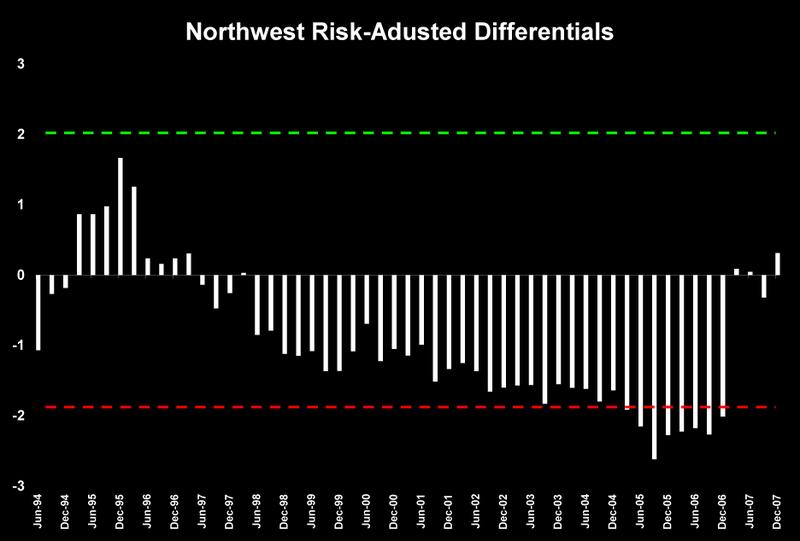
Think of RAD as a control variable. Companies with risk-adjusted differentials greater than zero are value creators. Those with RADs less than zero experience value migration. Since the standard deviation is one, a company that posts RADs greater that +2.0 is creating significantly more value than its peers. A company that posts RADs less than -2.0 is experiencing significant value migration.

DELTA’S ERATIC GLIDE
Chart 1 reports the value creation & migration pattern for Delta Air Lines over the same 55 quarters.

Chart 1

3_delta_rads_q294_to_q407_2

Through the first 29 quarters ending in June 2001 Delta's pattern of value creation and migration was erratic, reaching a high point of +1.6 in September 1999.  Delta clearly was tipped into decline by the attacks on the World Trade Center and the Pentagon. And the company continued to shed value right through December 2007.

NORTHWEST’S LONG SLIDE
Chart 2 is a plot of Northwest’s value creation and migration in each quarter. The series opens with three negative RADs beginning with the 2nd quarter of 1994. Then the company moves through a run of nine quarters of value creation peaking at +1.7 in December 1995.

Chart 2

4_northwest_rads_q294_to_q407_2

In June 1997 NWA entered into a period of continuous value migration that lasted through the 4th quarter of 2006. Initially, this value migration had nothing to do with the attacks on the World Trade Center and the Pentagon. But it certainly was aggrevated by those attacks as Investors continued to shift progressively more value away from NWA, finally culminating in bankruptcy.

SOUTHWEST’S HIGH RIDE
As Chart 3 shows, the value that migrated from its competitors went largely to Southwest. The company posted positive risk-adjusted differentials in every one of the 55 quarters in this study.

Chart 3

5_southwest_rads_q294_to_q407_2

Beginning in March 2000 Southwest posted value creation numbers greater than 1.0 in every quarter but March 2007. This performance is extraordinary. Chart 4 shows why.

Chart 4

Rad_distribution_bw

This is a plot of the distribution of risk-adjusted differentials for a large sample of companies in the study of Marketing’s Impact on Firm Value published by the Marketing Science Institute in 2003. Only 12 of the 337 companies in this study posted risk-adjusted differentials greater than +2.0 in all ten years between 1991 and 2000. Southwest Airlines did that for 18 quarters during, arguably the most turbulent period in domestic airline history.

RECONFIGURE OR REREGULATE
Given this history, and the failure of many large scale mergers, there are two ways to fix the airlines.

One is to break them up and reconfigure the parts. For example, spin off Northwest’s Asian routes along with Delta’s European routes and combine them in a public company that would offer formidable competition to Air France KLM, British Airways, and Lufthansa. Since all the aircraft in this new international airline would be big, this reconfiguration might go a long way toward solving the union's seniority problem. Then the domestic routes of both companies not required for international operations could be merged in a point-to-point/multiple-hub network. Then the aircraft, routes, landing rights, and gates that don’t fit the reconfigured domestic network could be auctioned off to the highest bidders. No doubt Southwest would buy more than a few of these and hire many of their employees too.

What's the other way to fix the airlines? Reregulate the supply side of the industry. What do you think of these options?

Thanks for visiting. As always I welcome your comments.

~V

March 09, 2008

Evaluating a Dysfunctional Industry

Doug Parker had a vision. His successful America West had completed a merger agreement with bankrupt US Airways Group on May 19, 2005.  With this deal he planned to become the dominant low cost carrier in the country as the new US Airways (NYSE:  LCC). And he would be its CEO. The next day CNN reported that "Parker thinks he can buck history and make a success out of merging his more successful airline with one in bankruptcy." The company's press release said:

Building upon two complementary networks with similar fleets, closely- aligned labor contracts and two outstanding teams of people, this merger creates the first nationwide full service low-cost airline.

On September 29, 2005 trading began for Mr. Parker's new carrier.  On that day its stock closed a little above $20. Then in a remarkable run-up to November 24, 2006 it was trading at around $63. Doug Parker seemed close to realizing his vision. Close, but no cigar. The run-up was followed by a steady erosion in shareholder value that on Friday March 7, 2008 saw his stock close at just under $11. That represented an 82% loss in value from its peak and a 46% loss from its initial price. What went wrong?

In a story US Airways Highlights Drawbacks of Consolidation published in USA TODAY on March 6, 2008 Dan Reed said:

The merged carrier ...  led by America West's management, had the second-best operating profit margin among all U.S. carriers last year and the best margin over the last two-year period. But widespread flight delays, a botched integration of the two airlines' reservations systems, a steep decline in service quality and plunging worker morale combined to alienate customers and employees alike.

A DYSFUNCTIONAL INDUSTRY
Over the period from 1990 through 2006 the Air Transportation Association of America reports that domestic airlines posted a cumulative loss of $22 billion on cumulative revenues $1,866 billion. Into Thin Air recounts the extraordinary history of this dysfunctional industry from its deregulation in 1978 to the present. In the New York Times story Roger Lowenstein explained the problem:

One reason the major airlines find themselves in this predicament is that they use huge amounts of fixed capital -- wide-body jets go for $100 million each and can't be readily liquidated. They also depend on a skilled labor force. The two problems exacerbate each other. Since airlines cannot afford to let planes sit idle, they can ill suffer strikes. That makes their unions unusually powerful. Consider some other businesses for a moment: Microsoft has highly skilled programmers but little invested capital. Merrill Lynch has both, but its assets -- stocks and bonds mostly -- could be liquidated overnight. Steel has high fixed capital, but it can replace its workers more easily.

Delta Air Lines (NYSE: DAL) filed for Chapter 11 bankruptcy-court protection on September 14, 2005. About a half-hour later Northwest (NYSE: NWA) also filed for bankruptcy. Then about a year later on November 15, 2006 US Airways made an $8 billion hostile bid to take over Delta. The court rejected this bid in favor of Delta's plan to emerge from bankruptcy.  Delta's financial adviser, the Blackstone Group, " ... estimated the value of a reorganized Delta at $9.4 billion to $12 billion in consolidated equity." On Friday DAL was worth $3.8 billion.

How can one possibly evaluate company performance in such a dysfunctional industry? If you really want to know, take 18 minutes to review this audio slide-show Y'all Buckle That Seat Belt from Chapter 3 of my book Competing for Customers and Capital.

THE SEXY BANANA
Possibly the funniest and, at the same time, most revealing account of Why Air Travel Doesn't Work appeared in a story by Timothy Smith in the April 3, 1995 issue of Fortune magazine:

The airline business, like the movie business and professional baseball, is so fundamentally sexy that many people can't resist it. Ever since Eddie Rickenbacker bought Eastern Airlines and Howard Hughes bought TWA, investors have been drawn to airlines for reasons going far beyond money. ... Passengers aren't immune to the industry's sex appeal, either: Flying often involves an implicit (if tiny) risk of death, the close proximity of strangers, and liquor. For all its ineffable allure, though, the airline industry is like the banana business. ... "We sell a perishable product, and it's like the last banana in the store: You can either get a penny for it or you can get nothing for it, so you sell it for a penny," says John Dasburg, chief executive of Northwest Airlines.

DOES 2+2=2?
Since my articles also are published on Seeking Alpha they get pretty wide exposure. Reactions to my last post on the Unintended Consequences of a Delta/Northwest Merger were mixed. In that article I averaged the closing prices and shares outstanding in coming up with a back-of-the-envelope valuation of the combined DAL and NWA. Which means I assumed that after all the dust settled, the combined airlines would be worth no more than one of them standing alone. A reader of that post on SA, identified as Bill @ Sabre, commented:

This is a very good way to look at the likely consequences of an airline merger. Typically in this industry, the financial press tries to make the case that a merger represents 2+2=5. The truth is that airline mergers more often look like 2+2=3. The after effects of mergers leave a drain on customer care, labor relations and ultimately the bottom line for many years.

Another reader, identified as a frm airline exec disagreed with that assessment:

Two companies of roughly comparable market caps merge, and the combined market cap is the average!!! How about the combined mkt cap is roughly double? ... If every NWA and DAL shareholder got one share of the combined company, there would be roughly twice as many shares outstanding. Thus, even if the share price didn't rise, as it would be expected to do in light of the presumed synergies of the combined company, the market cap would be double that of each stand alone company.

There are the magic words of mergers -- presumed synergies! Sounds like this former airline executive is a DAL shareholder. Or, perhaps, the CFO of a previously merged airline. In any event, this digression from the analysis of risk-adjusted differentials in the case of a DAL-NWA merger is needed to support my assumption that 2+2=2.

THE DOWNSIDE OF AIRLINE MERGERS
A good history of airline mergers from 1979 to date is available online in the Thomson Financial SDC M&A database. The results are surprising: when it comes to airlines, forget what you think about the expected downside of mergers.

The following table reports the M&A totals (excluding stock buy-backs) for the five airlines in my analysis with cumulative transaction costs from 1979 through 2007 that exceeded their year-end market cap.

Costvalue_of_airline_mergers_7907

The cumulative (nominal) M&A transaction costs of the five airlines were $29.6 billion. The market cap of these five companies at the end of 207 was $15.5 billion. The ratio of market cap to nominal transaction costs was 52%.

Delta led the pack with total M&A transaction costs of $10.5 billion.  Compared with a year-end market cap of $4.0 billion, this leads to the group's lowest MC/TC ratio: 38%. Over the years Delta management spent about $10 on M&A for every $4 worth of value they created. The most "successful" carrier among this list of M&A failures was US Airways -- with a ratio of 76%.

Little Southwest Airlines (NYSE: LUV) didn't make this list. Over the years Southwest management acquired stock in only three companies for a total of $309 million. Their company's market cap in December 2007 was $9.9 billion. So its MC/TC ratio was 32.04.

Y'ALL BUCKLE THAT SEAT BELT
And now Delta wants to merge with Northwest. Over the 30 years since deregulation these two companies spent $16.50 to create $7.50 worth of shareholder value. From this perspective it looks like $1.00+$1.00=$0.45. What do you think?

Thank you for visiting. As always, I welcome your comments.

~V

March 02, 2008

Unintended Consequences of Mergers

On December 31, 2007 Southwest's (NYSE: LUV) share of the $28.4 billion quarterly revenues generated by nine domestic air carriers was 8.4%. Question: What was LUV's share of market cap on that date?

Even if you have a large position in the stock, you may not know the answer. Why? Market share is a marketing metric. Does market share of group capitalization make sense?

SOME BACKGROUND

The overarching purpose of my book Competing for Customers and Capital is to forge links between finance and marketing. Specifically, to show how the markets for customers and capital interact in generating revenues and creating value. But before I jump into that, take a look at how market share most often is used in the press.

In their February 7, 2008 article, "Northwest and Delta Talk Merger," Andrew Ross Sorkin and Jeff Bailey make just one reference to market share, one which is not share of capitalization:

United, with strong Pacific routes, a big Chicago hub and a large market share on the West Coast, would complement Continental, which has big hubs in Houston and Newark and gets more of its revenue from international flights than any other big domestic carrier.

Similarly, in Jeff Bailey's January 17, 2008 NYT article,"In the Math of Mergers, Airlines Fail," he makes only one reference to market share, and again, it's one which is not share of market cap:

The second theory used to justify airline mergers is that combining would increase revenue because a bigger route system would help take market share from competitors.

In fact, references to market share in The New York Times are unusually frequent compared with other sources, including financial blogs. They may have a gut feeling about the importance of market share. The markets for customers and capital interact in many subtle ways that affect stock price. Which in turn affects revenue. The purpose of this new series on airline mergers is to show the importance of tracking that interaction.

THE BASIC DATA

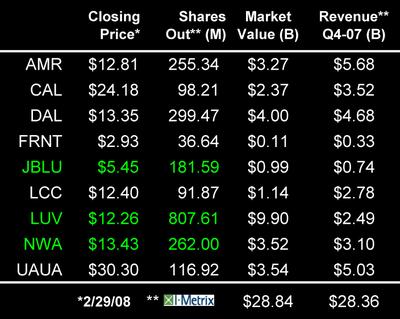
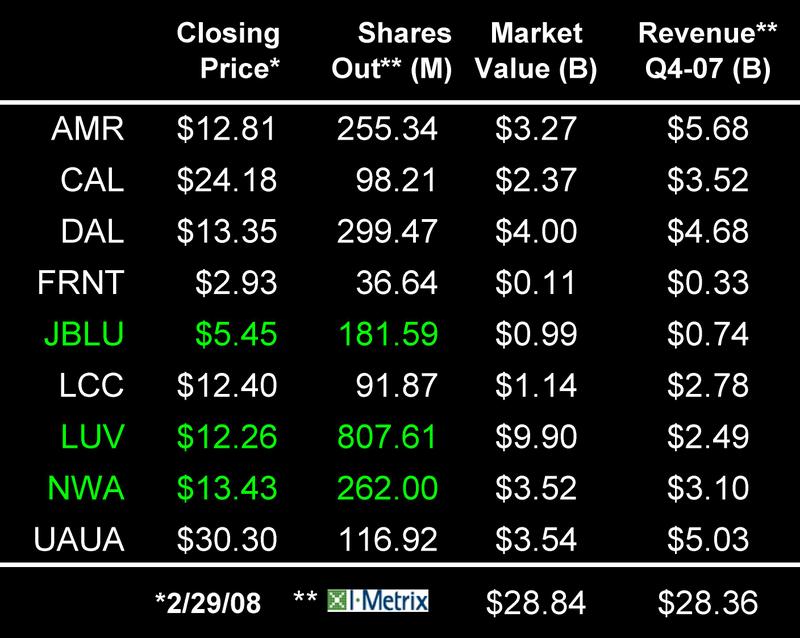
The following table presents the basic data on market value and revenues. The first column lists the ticker symbols of the nine airlines used in this analysis. The second column lists the closing price of each stock on February 29, 2008. This is followed by the number of shares outstanding (in millions) on December 31, 2007. Next market value in billions, the arithmetic product of price and shares out, appears in the 4th column. Finally revenues (in billions) are listed in the last column. The shares out and revenue data were downloaded from the EDGAR Online I*Metrix financial database.

Value_revenue_data_22908_2

By the way, notice the group's total market value ($28.84 billion) and revenue ($28.36 billion) are nearly equal. That is the group's value/revenue ratio is about one, which is exactly what I found to be the long-run expectation.

VALUE-REVENUE DIFFERENCES

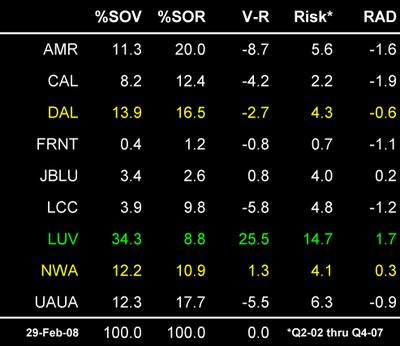
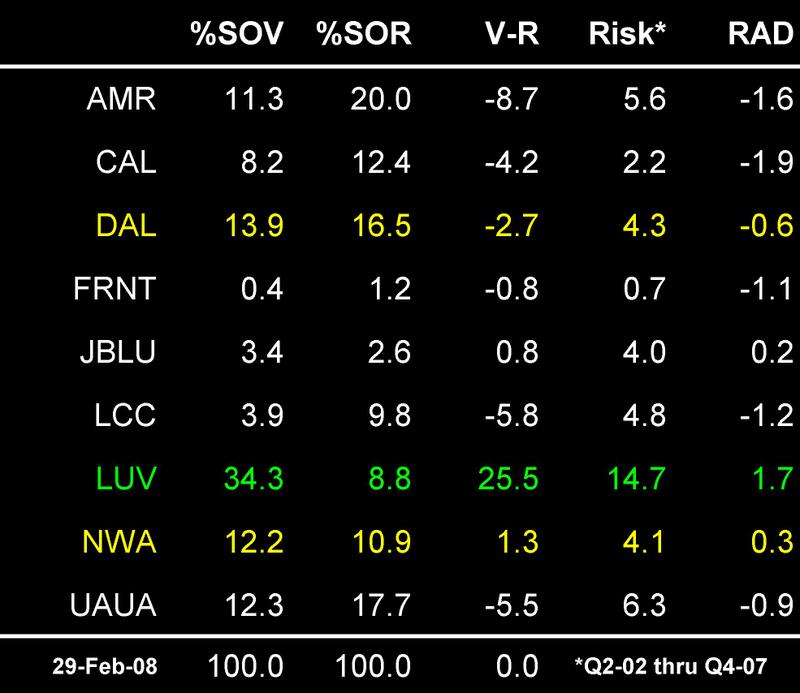
It's simple to convert the basic data into share of value [%SOV] and share of revenue [%SOR]. That's done in the following table for the same nine airlines. The value-revenue [V-R] differential is calculated in the 4th column. For example, American Airlines' (NYSE: AMR) value-revenue differential is -8.7%. The company generated 20.0% of revenues in the last quarter of 2007, but it created only 11.3% of the group's market value. Is this a bad thing? Yes, its market churn was nearly twice its value creation.

Value_sales_differential_table_22_2

The answer to the question I asked at the top of this post appears in the table above. LUV created 34.3% of the group's market value with only 8.8% of group revenues, or, the Southwest Airline employees share of value was about 4 times the share of revenue. Is this a good thing? Yes. If you're interested in the theory behind this metric and how it behaves over the long-run in the airline industry check out my audio slide show Y'all Buckle That Seat Belt.

HIGH-FLYERS AND BOTTOM-FEEDERS

Do data in the table above shed light on a possible merger brtween Delta (NYSE: DAL) and Northwest (NYSE: NWA)? Begin with their V-R differentials: DAL has a negative differential of -2.7 points while NWA has a positive differential of +1.3 points. The volatility [Risk] in these differentials is measured by their standard deviation over the 23 quarters from the Q2-02 through Q4-07: 4.3 and 4.1 respectively for DAL and NWA. Dividing the differentials by their risk creates a risk-adjusted differential [RAD].

Since it is a standard normal variable, with mean 0.0 and sigma 1.0, any value of RAD greater than +2.0 identifies a company as a high-flyer. Any company with a RAD greater that +2.0 is performing two standard deviations above the expectation. The chance of observing this extraordinary performance is about 5 in 100. In the last quarter of 2007 LUV was approaching this upper limit with a RAD of +1.7.

Alternatively, any company with a RAD less than -2.0 is a bottom-feeder. Its performance is two standard deviations below the expectation. The change of observing this weak performance also is about 5 in 100. In the last quarter of 2007 AMR was approaching this lower limit with a RAD of -1.5.

DAL+NWA = BOTTOM-FEEDER

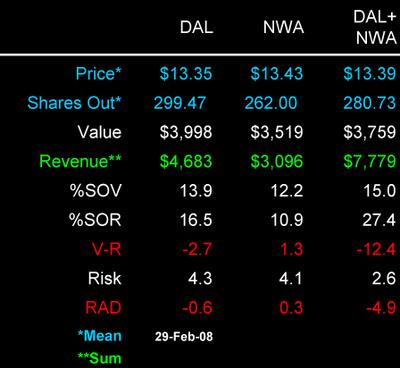
The following table summarizes the implications of a DAL-NWA merger using this theory.

Dalnwa_rad_22908_2

The markets have had plenty of time to anticipate effects of the merger and incorporate them into the prices of DAL and NWA. Both are valued at a little over $13 and both have a similar number of shares outstanding. So, a back-of-the-envelope valuation of the combined companies is the arithmetic product of the mean of their individual prices ($13.39) and shares outstanding (280.73 billion). This leads to a merged market cap of $3.759 billion. Taking a neutral point of view on the revenues of the combined companies, I added their Q4-07 revenues.

NOT A PRETTY TAIL

Under these assumptions the merged companies would have a %SOV of 15.0 and a %SOR of 27.4. Since the value share of combined companies historically is less volatile than the separate organizations, the standard deviation in their V-R differentials over the 23 quarters is 2.6. This returns a risk-adjusted differential of -4.9. Almost 5 sigmas into the negative tail of the distribution of risk-adjusted differentials.

Will this analysis prove to be accurate? Probably not. But it gives DAL and NWA management food for thought. Perhaps even more important it also gives them a new way to study the unintended consequences of a merger. What do you think?

Thanks for visiting. As always I welcome your comments.

~V